


+REgent Gifts 匯浚禮品


Before you brief a factory:
Decide whether a folding umbrella or a stick umbrella matches the way people will actually carry it. Then pick the cloth — pongee or polyester — and the ribs — metal or fibreglass — against the budget. If the umbrella also has to shade, ask whether the cloth has a UPF test, not just a “UV” line on the quote. Regent Gifts makes promotional umbrellas with a logo; send the use and the quantity if you want a style shortlisted.
Hong Kong’s wet season runs long, and a typhoon week is never a surprise, so a decent umbrella gets used. That is why custom umbrellas keep landing on giveaway lists for companies, school sports days and outdoor promotions. The canopy is large enough for a logo, and the person who receives a promotional umbrella will actually open it. The range is the problem. A folding umbrella, a stick umbrella, a golf umbrella and a reverse umbrella are not the same object, and the cloth and the ribs move both the feel and the price. This is how we at Regent Gifts walk a buyer through those choices before anyone signs off a custom logo umbrella order.
A stick umbrella is the long-handled one. The ribs do not fold, so the frame is simple and steady. The canopy is larger than a folding umbrella, which matters in heavy rain. Hotels, property offices and the better malls still put stick umbrellas out for visitors. The length is the drawback: it does not travel well.
A folding umbrella collapses. Two-fold, three-fold and even five-fold are the usual splits. Three-fold is the one we see most, because the packed length and the open canopy are both acceptable. Five-fold is the shortest when closed, small enough for a handbag. Two-fold sits between them: a bit longer than a three-fold, with a steadier frame. For promotional umbrellas and corporate gifts, three-fold is what most buyers pick.
A golf umbrella opens much wider than a normal stick umbrella, enough for a player and a bag. It is almost always a straight handle, so it drops into the umbrella sleeve on a golf bag. Rib count and materials are usually specified more carefully, and some use a double-layer vented canopy so wind has somewhere to go. Off the course, the same size works for outdoor events, property launches and mall promotions where one umbrella has to cover more than one person.
There are two versions. Auto-open springs open from a button. Auto open-and-close, sometimes called fully automatic, opens and shuts from the button, so one hand is enough. Either function can sit on a folding umbrella or a stick umbrella. It is the practical option when someone is carrying a bag and does not have a free hand.
A reverse umbrella folds the wet face inward and leaves the dry face outward. That is the whole point: getting into a car, a lift or a lobby does not drip on clothes or the floor. Open, it can stand upside down, so you are not hunting for a stand. The inside of the canopy can take a print, which is a different look from a logo on the outside.
An umbrella looks simple until you have to talk to a factory about it. These are the parts that come up on a spec:
| Part | Where it sits / what it does | Usual material |
|---|---|---|
| Finial (top cap) | Cap at the crown. It holds the canopy where the ribs meet. | Plastic, metal |
| Ferrule (tip) | Tip at the bottom of the shaft. On a stick umbrella it can rest on the ground. | Plastic, metal |
| Canopy | The cloth that blocks rain and sun, and the main place for a logo. | Pongee, polyester |
| Ribs | The frame running out from the shaft to hold the canopy up. | Iron, aluminium alloy, fibreglass, carbon fibre |
| Runner (top notch / bottom runner) | The pieces that join the ribs to the shaft. The top notch fixes the ribs under the crown. The runner slides on the shaft to open and close the umbrella. | Plastic, metal |
| Rib tips | Small caps at the end of each rib. They protect the canopy edge and reinforce the tip. | Plastic, metal |
| Shaft | The central pole. On a folding umbrella it telescopes. | Iron, aluminium alloy, fibreglass |
| Handle | The grip. Stick umbrellas often use a J-hook. Folding umbrellas usually use a straight handle. | Plastic, rubber, wood, EVA |
The cloth is what people feel, what the print sits on, and a large part of the price. These two are the ones that show up on promotional umbrella quotes:
| Point | Pongee | Polyester |
|---|---|---|
| Hand-feel | Softer, closer to cloth, matte | Stiffer, with a slight sheen |
| Takes colour well and holds fine detail. The usual cloth for custom promotional umbrellas. | Can be printed, but the surface does not look as good as pongee. | |
| Shade | A coating can be added | Silver or black coating is common, and the shade is more obvious |
| Cost | Mid to upper-mid | Lower |
| Wear | Good | Good |
Quotes often say 190T or 210T. T is thread count: warp plus weft threads per square inch. A higher number is a tighter, heavier cloth, and it generally holds water better. 190T is the spec most folding umbrellas on the market already use, and it is enough for ordinary rain. Our reverse umbrella (21101) and reverse-print umbrella (21102) are both 190T.
The ribs decide how the umbrella behaves in wind, and how heavy it is to carry.
The shaft — the centre pole — is usually iron, aluminium alloy or fibreglass. Aluminium is lighter, iron is heavier and cheaper, fibreglass is the lightest and the one that flexes.
Eight ribs is the ordinary count. More ribs make a rounder canopy and a steadier frame, and they add weight. A rainbow umbrella usually has 16 ribs, with a different colour of cloth between each one. Counts on the market run from 6 to 24. For a promotional umbrella, 8 is still the spec most orders use.
If the umbrella has to shade as well as keep rain off, ask whether the cloth has a UPF test. The Australian/New Zealand standard AS/NZS 4399 reads like this:
| UPF | Protection | UV transmission |
|---|---|---|
| UPF 15–24 | Good | 4.2%–6.7% |
| UPF 25–39 | Very good | 2.6%–4.0% |
| UPF 40–50+ | Excellent | ≤2.5% |
A UPF number can only be printed on cloth that has a coating — silver, black or titanium-silver are the usual ones — and has passed a test. Untreated cloth blocks some sun. It cannot carry a UPF figure.
Waterproofing is measured as hydrostatic head, in millimetres, under ISO 811. A higher number means the cloth takes more water pressure before it leaks. Ordinary umbrella cloth is already enough for normal rain.
The Hong Kong Observatory rainstorm signals are a useful reference when you are choosing, not just a news item:
Typhoons come through every year. In wind, the rib material matters more than the canopy size. Fibreglass flexes and is less likely to snap. A double-layer vented canopy lets wind pass through, so the umbrella is less likely to flip. Under Typhoon Signal No. 8, the sensible move is still to stay indoors.
A practical note: if the people receiving these will mostly use them in Hong Kong, spec fibreglass ribs. They cope better with the rainy season and the odd windy day.
The canopy is a large, flat-enough surface for a logo. These are the print methods that actually get used:
A canopy is usually 8 triangular panels. The common job is one panel with the logo: clear, and the cheaper way to do it. Two panels, four, or every panel are all possible if the logo has to be seen from more than one side. Full-panel printing is how you get an umbrella that is the artwork, not an umbrella with a logo on it.
Full colour, gradients and photo-level artwork can cover the whole canopy. It suits a complicated mark or a design with a lot of colour. It costs more than screen printing. The difference is visible.
A reverse umbrella shows its inside when it is closed. A pattern or a brand mark printed there is visible closed, and also from underneath when it is open. That option belongs to the reverse construction.
The canopy is not the only place for the brand. Handles and the tie can be made in a brand colour, and the sleeve can carry the logo. Matching the handle and the sleeve to a school colour or a brand colour is a small thing that changes how the set looks. Ask for a pre-production sample before the bulk run, and check the print colour and how the umbrella opens and closes in your own hands. Regent Gifts has a QC team on the goods, and can also make a logo box or a drawstring pouch to go with the umbrella. For the print methods themselves, see the logo printing guide.
The orders we see are sports day souvenirs, prizes for inter-school matches, graduation and alumni gifts, and giveaways on open day. Crest, school name and year on the canopy means the umbrella is still in use the next time it rains, so the mark stays out longer than a one-day item. For a school event, fix the date early and leave time for sample approval. Rushing the bulk run is how print colour goes wrong. If the day needs more than an umbrella, a sports towel can be made as part of the same set.
Corporate umbrella orders turn up for property and mall promotions, new-development sales, NGO fundraising, exhibition and seminar handouts, and staff gifts. A promotional umbrella with the company logo goes out every time it rains. Other corporate gift lines are on the hub if the umbrella is only one part of the brief.
A few jobs we have already made, and the styles behind them:


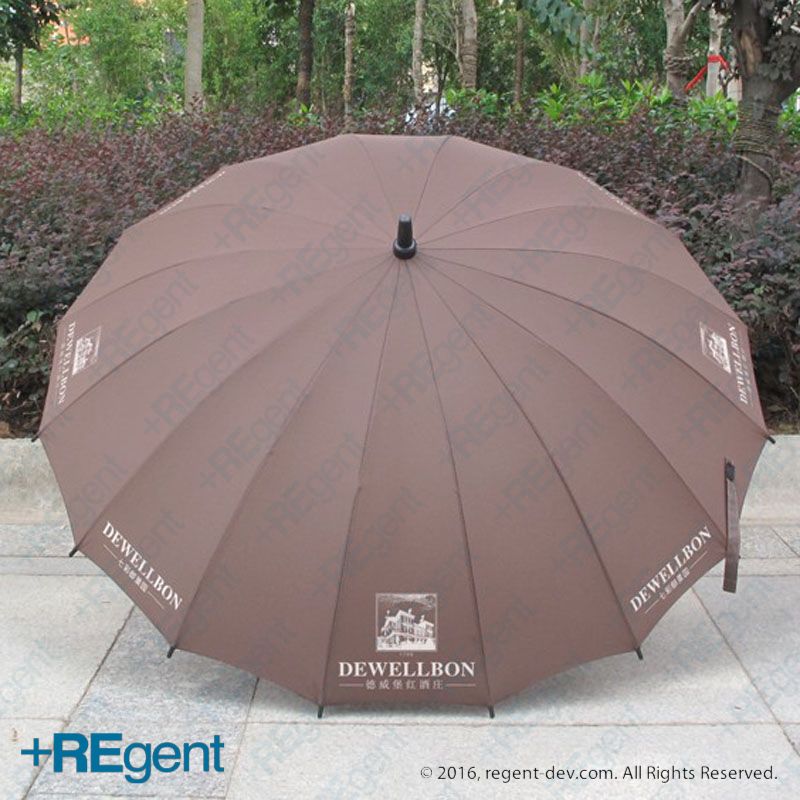


| Product | MOQ | Open size | Panels | Weight | Other points |
|---|---|---|---|---|---|
| 21103 16-rib rainbow umbrella | 100 | 98cm(W) × 81cm(H) | 16 | 450g | Rubber-coated handle |
| 21102 reverse-print umbrella | 100 | 107cm × 81cm | 8 | 560g | 190T; rubber-coated handle; 5 prints to choose from |
| 21101 reverse umbrella | 100 | 106cm × 86cm | 8 | 538g | 190T |
| 21284 24-inch double-layer umbrella | 300 | 24-inch stick umbrella | — | — | Double layer (logo on the outer, full-colour digital on the inner); PU leather J-handle |
* Specs follow the latest product page.
More styles are in the promotional umbrella catalogue.
If you already have a date or a rough artwork, send the use, the quantity, the style you have in mind and the date you need them. We will reply with a price and a suggestion.
If the brief is wider than umbrellas, the corporate gift hub lists the other lines, and the logo printing guide covers print methods.


