2026 corporate travel adapter buying guide
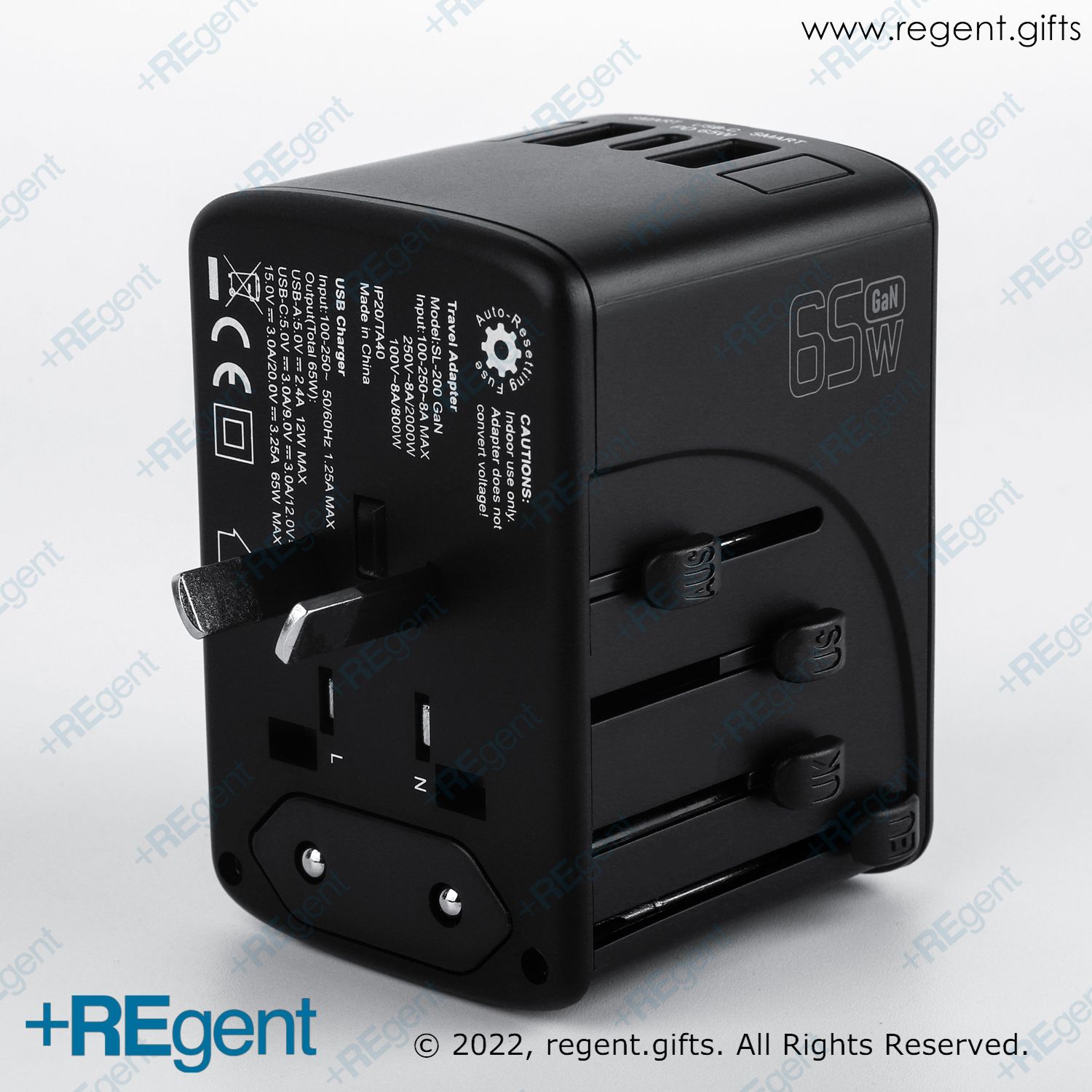
When companies order travel adapters, the usual snag is not the look of the product. Wattage is set too low so a laptop will not charge; someone treats it as a voltage converter and burns an appliance; a multi-port unit marked 65W splits power when two phones are plugged in. Start with the questions buyers ask most. Power is W = V × A. USB-C PD is the usual choice for gifts. If you need to cover iPhone 18 Pro and thin laptops, most orders pick 65W GaN. Logo printing is available. Minimum order is 200 or 300 pieces, depending on the model.
Key points first:
A universal travel adapter only changes plug shape. It does not change voltage. 20–40W is enough for phones and tablets as gifts. Official fastest wired charging on iPhone 18 Pro needs a ~60W-class USB-C charger (about 50% in about 15 minutes). For corporate orders, 65W GaN is the safer pick. USB PD 3.0 commonly tops out at 100W. PD 3.1 can go to 240W, but that is rare for gifts. A multi-port rating is total power, not per port. See the country plug chart. Follow-up is in Hong Kong.
The power calculator is below, plus the questions companies usually ask before they order.
1.) What does the W on the adapter mean?2.) What is the difference between W and V on an adapter?
⚡ Adapter power calculator (V × A = W)
3.) What is GaN?
4.) What are the benefits of Type-C on charging gear?
5.) What do the orange ports mean?
6.) What charging standards are in common use now?
7.) How many watts should a corporate gift use?
8.) What is the difference between a travel adapter and a voltage transformer?
9.) Is a GaN adapter worth ordering?
10.) Does 65W / 100W on the box mean every port can deliver that?
11.) What should I watch for with logo printing and minimum order?
12.) What safety marks should I check?
13.) What is the difference between buying adapters on Taobao and ordering from us in Hong Kong?
14.) If we order from you, how do payment and after-sales work?
1.) What does the W on the adapter mean?
A: The (W) on the adapter stands for watt, the unit of power — the maximum energy it can deliver per second. A higher number usually means faster charging, if the phone or laptop supports it.
Old 5W ratings are uncommon for corporate gifts. What you see more often now is 20W (phones), 65W (GaN; also charges thin laptops / iPhone 18 Pro), and 100W (higher-end multi-port). MacBook Pro, depending on the model, is roughly 65W to 140W.
If the adapter’s W is lower than the device needs, charging is usually just slower. It does not always fail at once. Long-term overload and heat are a safety risk. Before you order, say whether you only need phone charging, or laptops as well.
2.) What is the difference between W and V on an adapter?
(W) and (V) on an adapter stand for power and voltage. They are different quantities, with different units and meanings.
(W) stands for watt, the unit of power — energy used per second. The (W) on an adapter is usually the maximum power it can deliver.
(V) stands for volt, the unit of voltage — the potential difference between two points. The (V) on an adapter is usually the voltage range it can accept.
They mean different things, but they are linked: power equals voltage multiplied by current. Both figures affect charging speed. When you pick a charger, match the device’s power need to the adapter’s maximum power and voltage range. If the device needs more power or a different voltage than the adapter can supply, charging may be slow, fail, or in some cases risk damage.
Adapter power calculator
Power (W) = voltage (V) × current (A). Use the calculator below to get the output power.
Power calculator
| Voltage (V): | V |
| Current (A): | A |
| Power (W): |
--
|
Common charging specs
| Charging type | Voltage (V) | Current (A) | Power (W) |
|---|---|---|---|
| Basic USB charging | 5V | 1A | 5W |
| Faster USB (iPad) | 5V | 2.4A | 12W |
| Quick Charge 2.0 | 9V | 2A | 18W |
| Faster charging | 9V | 3A | 27W |
| PD charging | 12V | 3A | 36W |
| Laptop charging | 15V | 3A | 45W |
| USB PD 3.0 | 20V | 3.25A | 65W |
| USB PD 3.0 common ceiling | 20V | 5A | 100W |
| iPhone 17 ~40W class | 9V | ~3.3A | ~30–40W |
| iPhone 18 Pro ~60W class | 20V | 3A | 60W |
| USB PD 3.1 EPR (uncommon for gifts) | 28V | 5A | 140W |
| USB PD 3.1 spec ceiling (rare for gifts) | 48V | 5A | 240W |
| MacBook Air (slow charge) | 20V | 1.5A | 30W |
| MacBook Air (faster charge) | 20V | 3.25A | 65W |
| MacBook Pro 13" | 20V | 3A | 60W |
| MacBook Pro 14" (common step) | 20V | 4.7A | 94W |
| MacBook Pro 16" (standard) | 20V | 4.7A | 94W |
| MacBook Pro 16" (highest power) | 28V | 5A | 140W |
Tip: Click any row to fill the calculator. Actual power drawn by an iPhone is negotiated between the phone and the charger; the table is a rough guide. MacBook Pro 14" can also be 70W / 96W / 140W depending on the chip. 140W / 240W need a 5A EPR cable. Corporate gifts rarely go that high.
3.) What is GaN?
GaN (gallium nitride) is a semiconductor material inside the charger. Compared with silicon, it is more efficient and runs cooler, so the same 65W / 100W unit can be a bit smaller. That suits travel adapter gifts.
For 2026 corporate orders, 65W and above is where you clearly notice “smaller and less heat”. For a basic 20W phone charger, silicon is fine and costs less.
GaN itself is not a charging protocol. Phones look for USB PD, QC and similar standards. GaN just makes it easier to reach high wattage in a small body. See GaN travel adapters.
4.) What are the benefits of Type-C on charging gear?
Type-C (USB-C) is small and reversible. The EU requires USB-C on new phones. iPhone 15 onward, iPhone 17, and iPhone 18 Pro all use this port. So do Android, newer iPads, and Macs.
Type-C on a travel adapter is usually charge-only. It does not mean you can copy files. File transfer depends on the cable and whether the devices support USB 3 / USB4 — that is separate from the adapter’s charging port.
For charging, Type-C with USB PD commonly reaches 65W or 100W. On paper PD 3.1 can go to 240W, but corporate gifts rarely do. Older USB-A fast charge usually stays in the teens to a few tens of watts, and needs matching protocols such as QC.
5.) What do the orange ports mean?
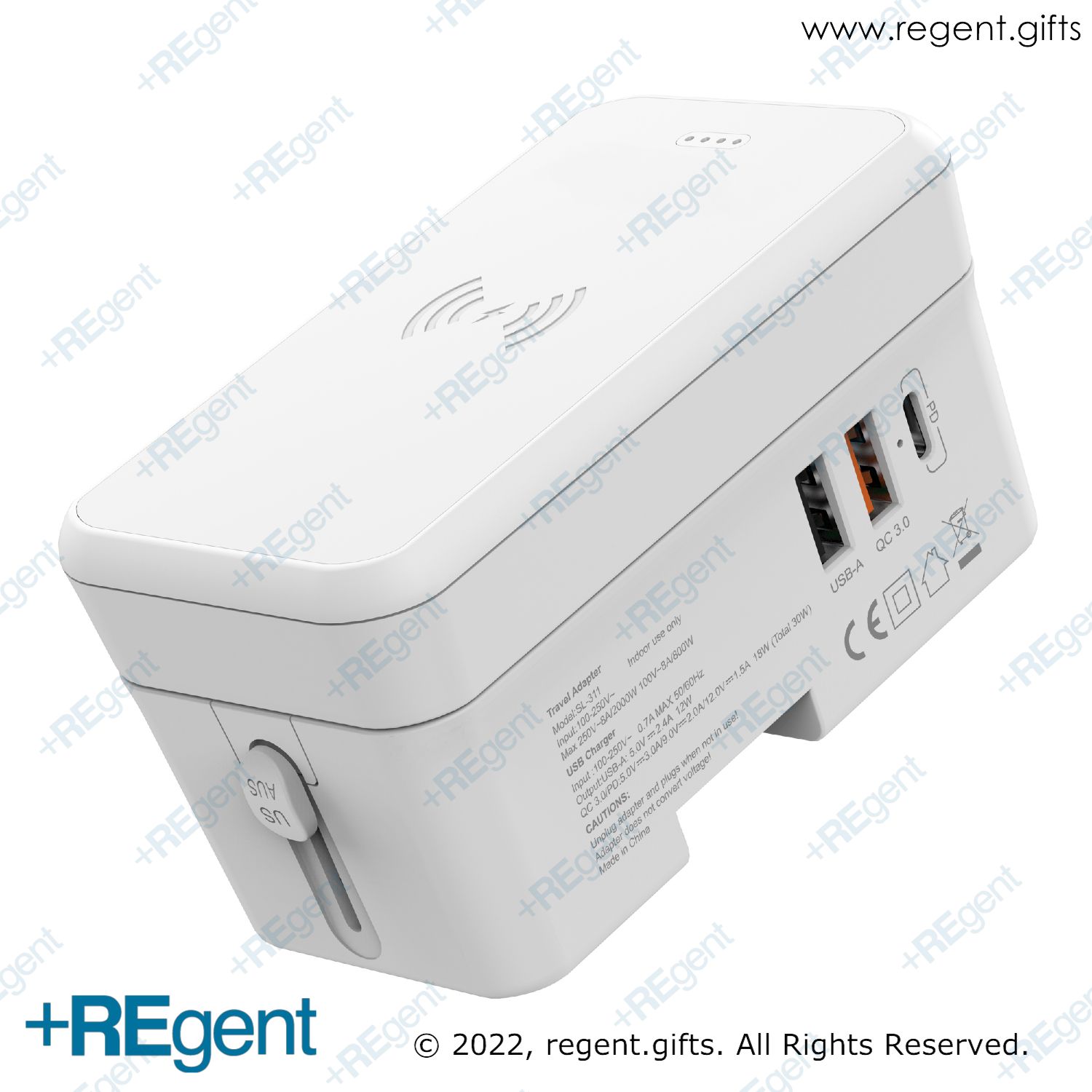
Orange USB-A on gift travel adapters is usually the maker’s mark for a dedicated fast-charge port (often Qualcomm QC). It is not a USB-IF rule that “orange = some official standard”.
USB BC 1.2 is an older charging protocol, about 7.5–12W at most. Few people ask about it now. When you order, go by QC and USB PD printed on the box or spec sheet. Do not judge by colour alone.
Type-C is now the main fast-charge port. Orange USB-A is usually for older cables and older phones.
6.) What charging standards are in common use now?
- USB PD (Power Delivery): the standard corporate gifts should list. Used with Type-C. PD 3.0 commonly tops out at 100W. PD 3.1 EPR can reach 140W / 240W. That is uncommon for gifts, and it needs a 5A EPR cable.
- PPS / AVS: finer voltage control under PD. Many Android phones use PPS. Official fastest wired charging on iPhone 18 Pro (about 50% in about 15 minutes) asks for a ~60W-class charger that supports Adjustable Voltage Supply (AVS). A regular 65W PD charger will still charge quickly; it just may not hit the official top speed.
- Qualcomm Quick Charge (QC): more common on USB-A. Newer phones rely less on QC alone. Gift adapters sometimes keep one QC port for older cables.
- USB BC 1.2: older protocol, around ten watts. Few people ask about it now.
- Brand-specific fast charge (for example older Samsung AFC): only useful on that brand’s older phones. Do not treat it as a main reason to order a corporate gift.
7.) How many watts should a corporate gift use?
A: First ask what the recipient will charge. Do not chase the highest wattage by default.
From iPhone 15 onward, and on most Android phones, 20W to 40W is already faster than old 5W. Official fastest wired charging on iPhone 18 Pro / 18 Pro Max (about 50% in about 15 minutes) needs a ~60W-class USB-C charger. For corporate orders, 65W GaN is the safer pick, and it also covers many thin laptops. 14-inch / 16-inch MacBook Pro can be 70W, 96W, or 140W depending on the chip. Gift models rarely reach 140W. Say how it will be used before you order, so the laptop does not arrive and sit on a slow charge.
| Use | Suggested wattage |
|---|---|
| Phones / tablets / earphones only | 20W–40W |
| iPhone 18 Pro near official fastest wired charge | 65W GaN (60W class) |
| Also MacBook Air / thin laptops | 65W GaN |
| Higher-end MacBook Pro | Check the model first; gifts usually stop at 65–100W |
8.) What is the difference between a travel adapter and a voltage transformer?
A: This is the question that most often causes damage. A universal travel adapter only changes plug shape. It will fit UK, EU, US, and AU wall sockets (depending on the model). Voltage does not change.
Most phone and laptop chargers now say 100–240V, so you can use a plug adapter in Japan, the US, or Europe. Older hair dryers and some shavers marked only 110V or only 220V can burn out — and can be unsafe — if you take them to a country with the other voltage. These adapters do not convert voltage. At most they make the plug shape fit (depending on the model). See the country plug chart.
9.) Is a GaN adapter worth ordering?
A: If the budget is tight and you only charge phones, a 20W silicon model is enough. Choose GaN if you want something smaller, cooler, and able to charge a laptop. The difference is clearest at 65W and above: luggage is a bit lighter, and a row of them on a meeting-room table runs less hot.
GaN costs more because of the material and the build, not because a word was printed on the box. For business gifts, overseas trips, and trade-show travel, it is usually worth it. See GaN models.
10.) Does 65W / 100W on the box mean every port can deliver that?
A: No. 65W or 100W on the box is usually total power. With one device, the main Type-C port can use most of it. With two phones plus a tablet, power is split, and a laptop may drop to a slow charge.
Ask when you order: do you need one device to use the full 65W, or do two devices plugged in at once still need to charge quickly. 65W on the box does not mean both ports give 65W at once.
11.) What should I watch for with logo printing and minimum order?
A: Travel adapters can take a logo. Placement depends on the model: the shell, a sliding cover, or the box. Very thin lines and too many spot colours smear on a small surface. A vector file (AI, CDR) is more reliable than a website screenshot. Give a Pantone if you can. Sign a sample, then run the rest.
Minimum order depends on the model: some start at 200 pieces, some at 300. Use that model’s product page or quotation. Do not assume every model is 200. Printing details are on gift logo printing. Models are under travel adapters.
12.) What safety marks should I check?
A: These gifts plug into a wall. Safety matters more than a neat print. At least ask: is there a fuse, is there an earth pin (depending on the destination), and is there CE or another mark for that market. Cheap units with no fuse, loose pins, or heavy heat are not worth the few dollars saved.
We can provide certificate details by model. Say which countries they will be used in, so we can match plug type and marks.
13.) What is the difference between buying adapters on Taobao and ordering from us in Hong Kong?
A: Taobao is cheaper and has more models. Buying one or two for yourself is fine. Corporate orders usually stall in two places: a skewed print, or units that arrive hot or with loose pins, which are hard to chase across a border; and payment that has to follow the marketplace, which company accounts often cannot use easily.
Here you order in Hong Kong. Pay the way your company already pays. If the print is wrong, the wattage was ordered wrong, or the goods have a problem, we handle it. Minimum order is 200 or 300 pieces, depending on the model.
14.) If we order from you, how do payment and after-sales work?
A: Payment follows the methods Hong Kong companies already use, which is easier to reconcile than a marketplace charge. Which method we use can be confirmed when you order.
After-sales is simple: if there is a problem, you come to us. Print, wattage, certificates, and quantity on arrival — we follow through. The main difference from a marketplace is not extra promises on a page. It is that someone is accountable if something goes wrong.